stappone Sensor Insoles as the Gold Standard
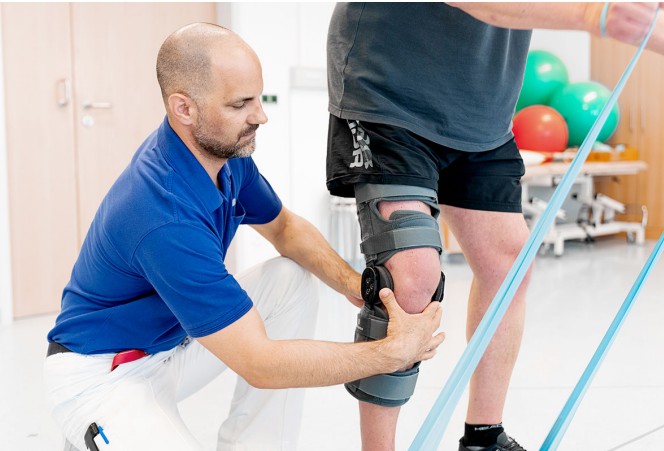
Christoph Oratsch, Head of the Physiotherapy Department at UKH Klagenfurt, training with the help of stappone insoles (Copyright: Maximilian Skanda)
stappone Sensor Insoles as the Gold Standard in Rehabilitation
The intelligent sensor insoles from stappone provide real added value in modern rehabilitation, particularly in partial weight-bearing. At UKH Klagenfurt, they are already used as a standard tool and are applied daily by the entire physiotherapy team.
“By now, stappone insoles have become a fixed part of our program. We consider them the gold standard for optimizing and accelerating rehabilitation, both in partial weight-bearing and in mobile gait analysis, while specifically identifying and correcting compensatory mechanisms,” explains Christoph Oratsch, Head of Physiotherapy at UKH Klagenfurt.
Suitable for All Age Groups
At UKH Klagenfurt, patients of all ages are treated – from adolescents to older adults. “Our youngest patient is around 14 years old, the oldest over 80,” says Oratsch.
The major advantage of the stappone sensor insoles lies in the objective assessment of movement patterns. Instead of relying on subjective evaluations, the system delivers clear, measurable data. “We see exactly what is happening, not what we believe we are seeing.”
Objective Feedback Creates Confidence
A key element of stappone technology is the immediate feedback provided to patients. Visual and acoustic signals guide them during movement and allow them to correct improper weight distribution instantly.
This is particularly crucial in partial weight-bearing therapy. While conventional methods often rely on estimating how much weight is placed on a limb, the sensor insoles provide precise feedback in cases of overloading or underloading. This creates a sense of security, reduces fear of making mistakes and increases motivation which is an essential factor in accelerating rehabilitation.
Partial Weight-Bearing as a Core Focus
At UKH Klagenfurt, the primary focus is clearly on partial weight-bearing. All patients benefit from this approach, especially older individuals. They can see and understand their movement patterns and often begin correcting them independently even before a detailed analysis is conducted.
The result: shorter rehabilitation times, more targeted therapy approaches and clear advantages for both sides. Physiotherapists save valuable time by relying on data-based analyses while also gaining confirmation of their professional assessments. All these factors significantly increase motivation.
Mobile Gait Analysis in Sports and Post-Accident Rehabilitation
In addition to partial weight-bearing, mobile gait analysis plays a key role, especially in sports rehabilitation and post-accident recovery.
“It helps us identify pathologies and compensatory mechanisms that the body has developed,” Oratsch explains.
Improper loading patterns during walking are often difficult to detect with the naked eye. With stappone sensor insoles, however, they become clearly visible and can be addressed in a targeted manner. For example, a shortened stance phase or dominant rearfoot loading can be objectively measured and corrected before leading to more significant issues such as pelvic misalignment.
Practical and Efficient in Clinical Operations
The physiotherapy department at UKH Klagenfurt consists of an eleven-member team that uses the sensor insoles daily. Depending on postoperative progression, around five patients per day receive partial weight-bearing therapy. The use of the insoles is an integral part of the standard procedure.
Patient feedback is consistently positive, regardless of age. “The quality of feedback is truly excellent. The application is simple and the technology, especially the synchronization between insoles and the app, is constantly improving. This allows even short therapy sessions to be used optimally,” says the physiotherapist.
Added Value for Therapists and Patients
What makes the stappone sensor insoles particularly valuable for Christoph Oratsch?
“I receive objective data that gives me confidence and confirms my professional assumptions.”
As a result, not only do patients benefit, but physiotherapists and physicians also gain greater trust, precision, and quality in rehabilitation.
“We are operating at an exceptionally high level,” says stappone CEO Peter Krimmer. “Step by step, we help people return to movement and that very idea is what drives us.”